Still recording your online course instead of selling it?
15 August 2026 · 7 min read

How many lessons have you recorded so far? And how many rupees has the course made? If the first number is comfortably bigger than the second, you are not building a course. You are hiding in one. We say that with affection, because almost every creator does it.
Course launches die in three specific places. Four months of recording before anyone is asked to pay, a checkout that cannot take UPI, and one scary price with no instalments. None of those are content problems. They are setup problems, and all three are fixable this week.
Why most online courses never launch

Recording feels like progress, which is exactly what makes it such a good hiding place. Every re-shot lesson is a day you did not have to find out whether anyone will actually pay. Then the launch finally comes, the checkout asks a phone-first buyer for card details, the price sits there as one intimidating number, and the silence that follows gets blamed on the content.
So flip the order. Sell first, record alongside, and fix the two setup things that quietly eat your sales.
How many lessons does your first course actually need?
Fewer than you are planning. Six to ten is usually the honest answer, and here is why that is not laziness. Nobody buys a course because it has forty lessons. They buy it because it takes them from where they are to one specific place they want to be. Clear skin. A passed exam. Their first freelance client. A cake that actually rises.
Forty lessons that cover everything and promise nothing will lose every time to eight lessons that promise one thing and deliver it. The long course also has a quieter cost: nobody finishes it, and people who do not finish do not leave reviews, do not tell their friends, and do not come back for the next thing.
Record on your phone, in good light, with a cheap collar mic. You do not need the ring light, the second camera, or the intro animation you have already spent two evenings on. Nobody has ever asked for a refund because the b-roll was weak.
Students care about one thing: that you explain it clearly, in the language they think in. That is the whole product. Everything else is you being nervous, which is understandable, but it is not content.
Price it for the people actually buying, then add instalments
A quick map of what works. ₹499 to ₹2,999 for a mini course or a recorded workshop, ₹1,999 to ₹9,999 for a structured full course.
Above roughly ₹2,000, EMI stops being a nice-to-have. The same course at ₹4,999 feels like a decision to sleep on; at ₹833 a month it feels like a subscription someone can start today. You still receive the full amount, because the instalments are between the buyer and their bank.
For your first cohort, price lower than feels comfortable and ask for honest feedback in return. Twenty students who paid and finished give you testimonials, a customer list and a much better second version. That is worth more than a premium price on an empty course.
Why your checkout has to lead with UPI
This is where most course sales quietly disappear. Your student is on a phone, GPay open, ready. If your checkout leads with card fields, most of them close it, and they never write to tell you why. UPI has to be the first thing on the payment screen, not an option hidden behind “other methods”.
The QR-code-in-DM approach deserves a serious word here, because the stakes are different at course prices. No receipt, no record, no refund trail, and you personally verifying every screenshot. Now ask it from your buyer's side. They are being asked to send ₹5,000 to a personal UPI ID belonging to someone they have never met, with nothing at all protecting them if you vanish. Most people, sensibly, will not. That is not a checkout problem, it is a trust problem, and it caps your course at however many payments you can verify by hand.
Deliver course access instantly, and keep their progress
The minutes between “payment done” and “I’m in the course” are where refund requests are born. Access should arrive on WhatsApp in seconds, automatically, with a receipt.
After that, the thing that keeps students actually finishing is boring infrastructure: lessons in order, progress saved so they resume where they stopped, quizzes to check they followed, a certificate at the end. Students who finish leave reviews and buy your next thing. Students who lose their place go quiet.
How to sell your course from Instagram
You do not need a website. Your storefront link in your bio is the shop. What sells the course is reels about the problem it solves, ending with “comment COURSE and I’ll send the details”. Then automation DMs each commenter your link within seconds, and follows up with the ones who opened checkout and didn’t finish.
More on that in selling on Instagram without a website.
What it feels like when it finally works
A message arrives at 11:40pm. Someone you have never met has paid ₹2,499 for eight weeks of your knowledge, and by the time you have read the notification, they are already inside lesson one. You did not send anything. You did not check anything. You were making chai.
That is the actual difference between a folder of video files and a course. Not the production quality. The fact that it runs without you standing next to it.
How to build and sell your course on Creatly
Enough theory. This is the part where the course stops being a folder of video files and starts being something people can buy.
Step 1: Create the course and price it
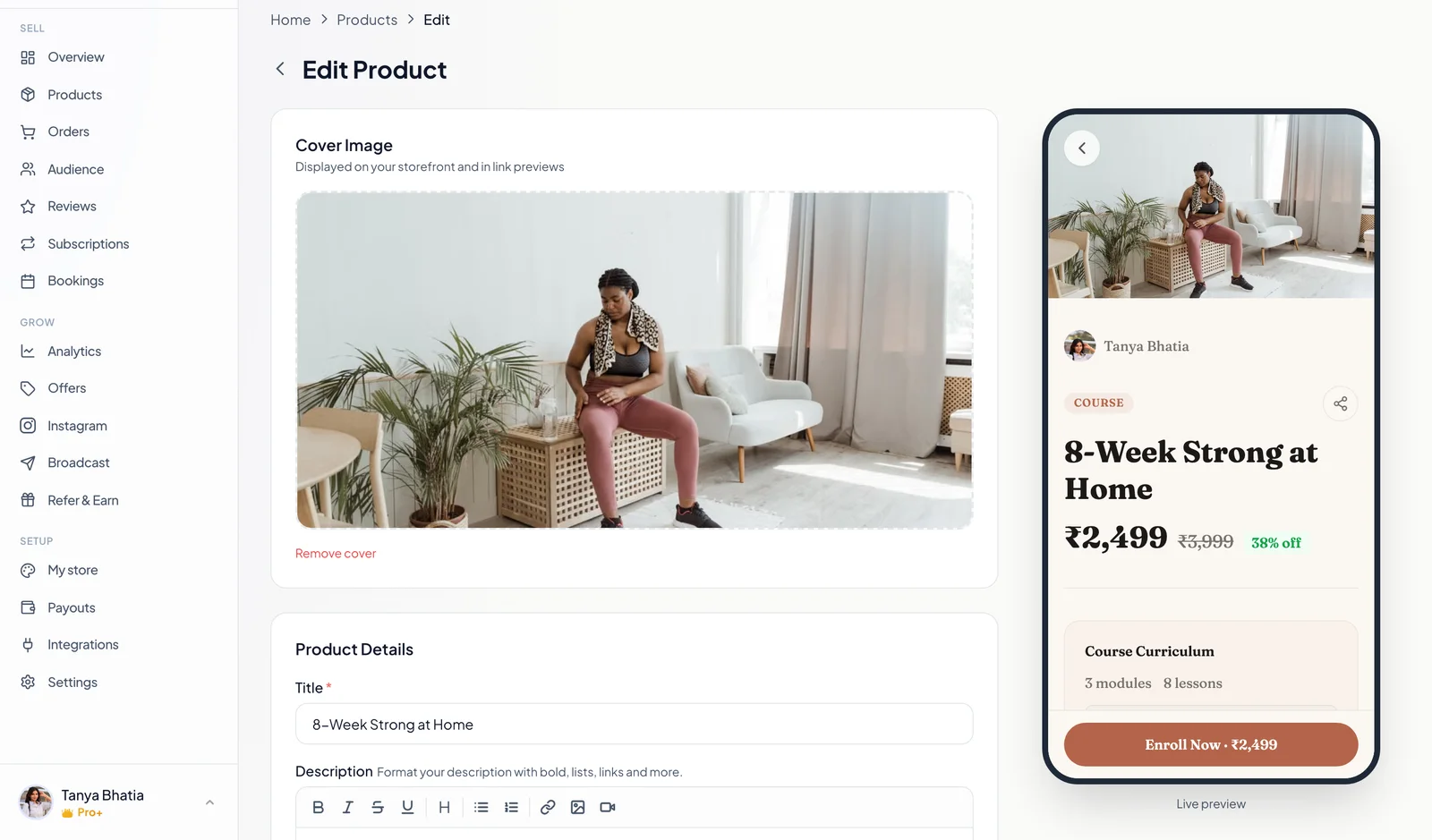
Products, then New, then eCourse. Title it, add a cover, and write two honest lines about what the student walks away with. The panel on the right is a live preview of the page they will land on, so you are never guessing what it looks like.
Step 2: Build the curriculum
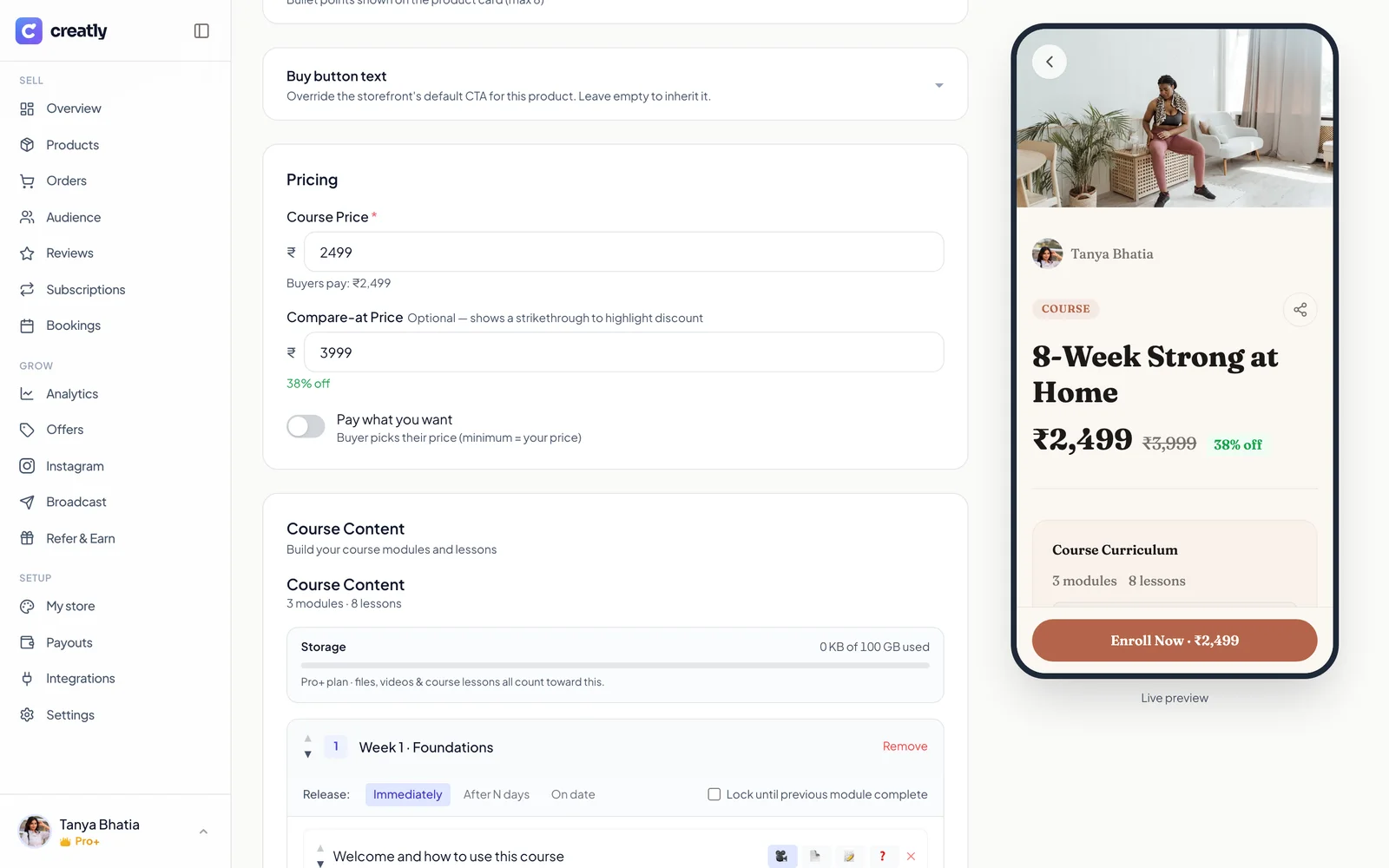
Add a module per week or per theme, then lessons inside each one. Video, PDF, text and quizzes all sit side by side. The bit worth your attention is Release. Set a module to unlock immediately, or after a number of days, or on a fixed date, and you have a drip course without doing anything else. Students who get everything at once tend to finish nothing.
Step 3: Publish and enrol your first students
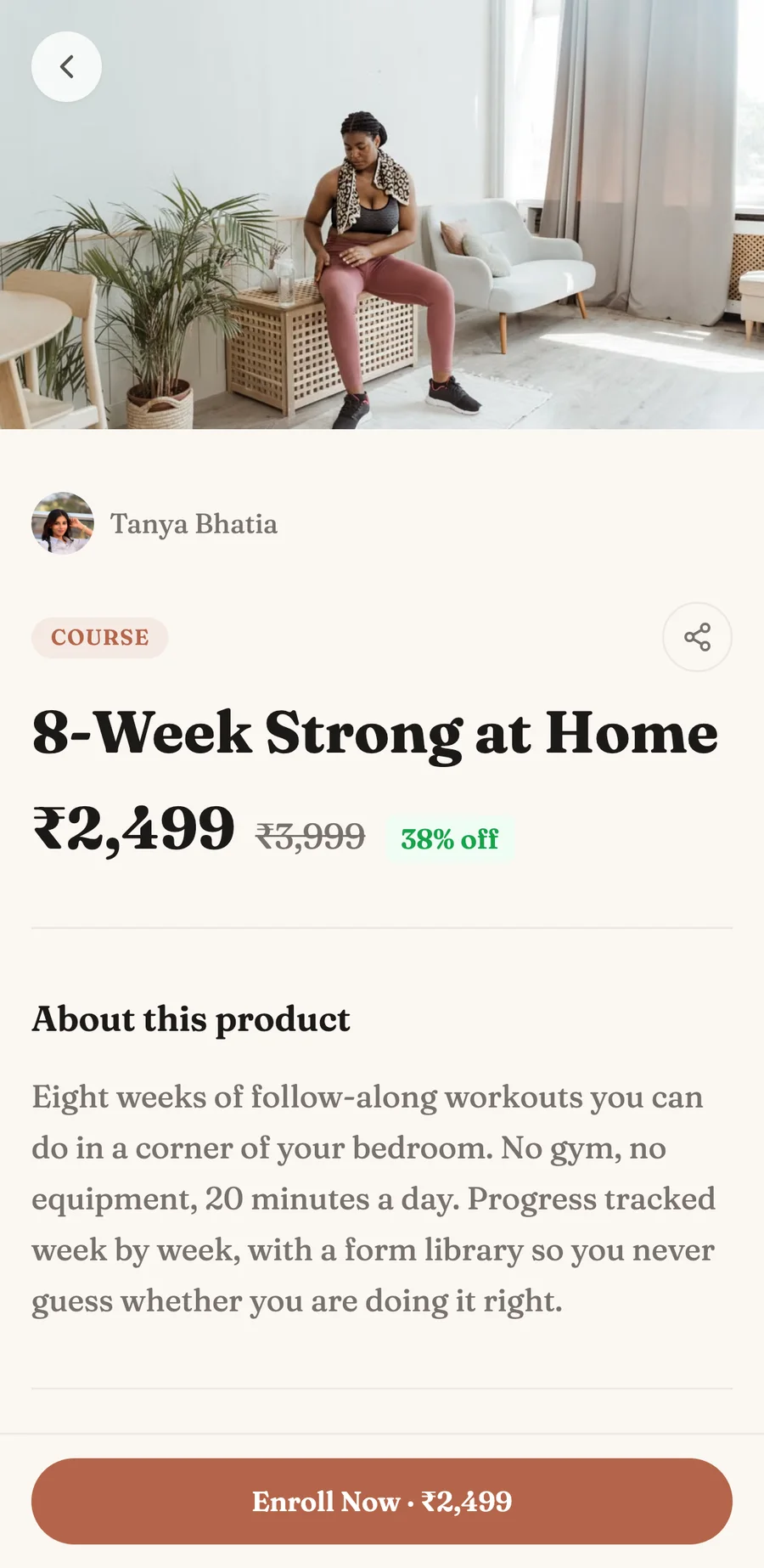
Publish and the course appears on your storefront. A student pays, access lands on their WhatsApp within seconds, and they get an account where the player remembers exactly which lesson they stopped on. You never send a link, chase a payment or explain how to log back in.
Frequently asked questions
What is the best platform to sell online courses?
The one whose payment and delivery rails match your students. That means a checkout offering the methods they already use, instalments on bigger tickets, access delivered somewhere they will actually open, and a fee structure that does not charge you before you have sold anything. Creatly is built to that spec, with a full course player, checkout on cards, UPI and EMI, payouts in T+2 days, and a free forever plan with a 6% fee only on actual sales.
How much should I charge for an online course?
Mini-courses and workshop recordings usually sit between ₹499 and ₹2,999. Full courses with structured modules run ₹1,999 to ₹9,999. Above roughly ₹2,000, offering instalments matters more than the price itself. ₹4,999 reads as a big decision, while ₹833 a month reads as an easy one. Start lower than feels right for your first cohort; testimonials from twenty paying students are worth more than a higher price on zero sales.
Do I need a website to sell a course?
No. A storefront link in your Instagram bio does the entire job. Students see the course, pay, and get access without a website existing anywhere. Building a site first is the most common way people delay their launch by six months.
How do students access the course after paying?
On Creatly, access lands on their WhatsApp within seconds of payment, and they get a buyer account they can log into anytime. The course player keeps their progress, so they resume exactly where they stopped, on any device, with no chasing you for links.
Should I sell a course or a membership?
A course is a one-time purchase for a fixed outcome. A membership is recurring income for ongoing access such as updates, a community and monthly sessions. Most creators do best starting with the course, then adding a membership for the students who want to stay close. Creatly supports both, with membership access to Telegram and Discord managed automatically as people join and lapse.
What if my students are spread across different countries?
Then the checkout matters more than anything else. Pick a platform that offers your students the payment methods they actually use at home, rather than one that assumes everyone pays the same way. Creatly checkout takes cards, UPI and EMI, so most audiences are covered without you setting anything up.
Everything above, the course player, UPI and EMI checkout, WhatsApp delivery, buyer logins and Instagram automation, is in Creatly, and you can build the whole course on the free plan before paying anything. Also worth reading: how to choose a platform, in eight checks and how to run a paid Telegram community for your students. If nobody is finishing it, try releasing it a week at a time.