The Reflective Scholar: Practical Research Methods, Academic Writing & Statistical Analysis
Free sample
21 of 453 pages


 The rest is locked
Tap a page to read the free sample
Why Rigorous Research Projects Stall
Every year, thousands of postgraduate scholars, doctoral candidates, and independent investigators encounter a frustrating impasse. The barrier is rarely a lack of intellectual capability. The real breakdown is procedural:
Research questions framed too broadly to investigate empirically.
Literature reviews assembled as disconnected summaries rather than systematic syntheses.
Methodological confusion between qualitative, quantitative, and mixed approaches.
Statistical tests selected haphazardly after data collection rather than derived from measurement models.
Manuscript rejections citing unaddressed confounding variables, opaque reporting, or broken citation chains.
Most methodology manuals remain trapped in abstract philosophy or reduce empirical work to superficial tips. The Reflective Scholar bridges the chasm between textbook theory and defended academic execution.
What This Guide Is
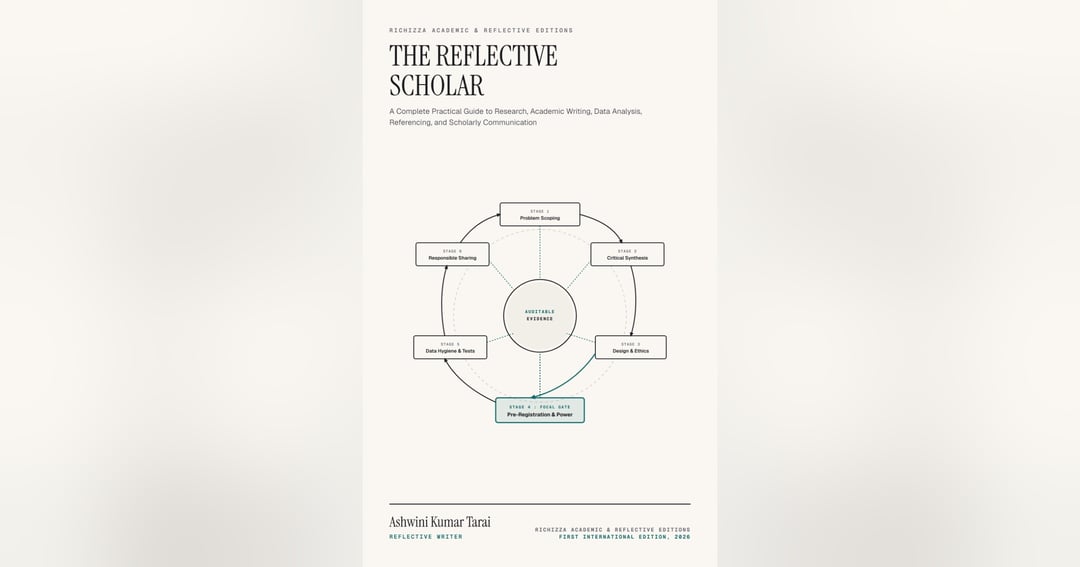
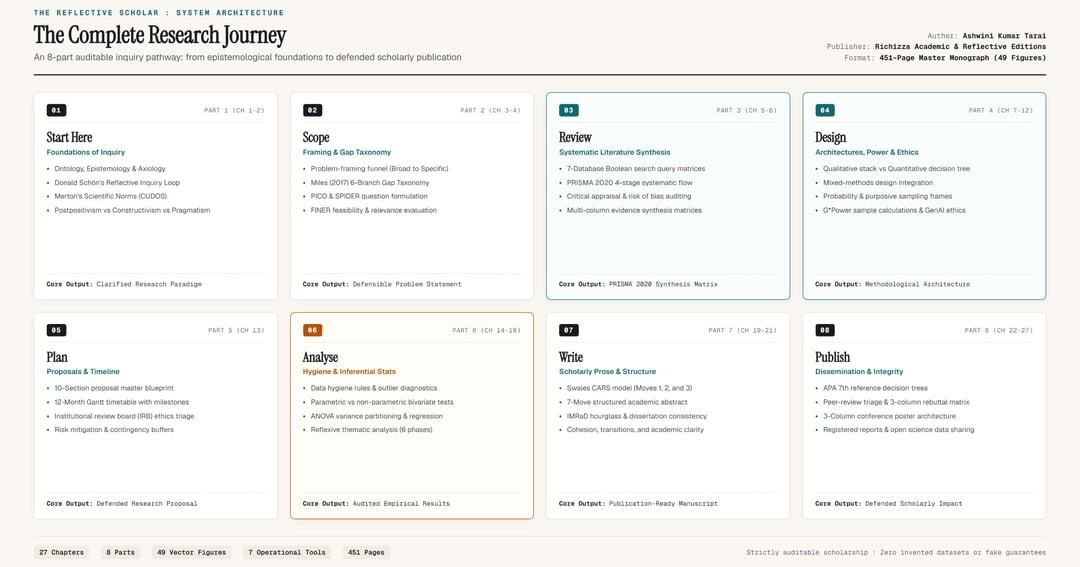
The Reflective Scholar: A Complete Practical Guide to Research, Academic Writing, Data Analysis, Referencing, and Scholarly Communication is an institution-neutral, 451-page empirical research manual. Authored by Ashwini Kumar Tarai and published by Richizza Academic & Reflective Editions, this First International Edition provides an auditable, step-by-step roadmap spanning the complete scholarly inquiry lifecycle.
Grounded in Donald Schön's reflective practice and Robert Merton's institutional scientific norms (CUDOS), the text deconstructs scholarly inquiry into repeatable, transparent, and defensible procedures.
Who It Is For
Doctoral and Master's Scholars: Preparing research proposals, institutional ethics submissions, literature syntheses, or dissertation defenses.
Early-Career Academics and Postdoctoral Fellows: Transitioning from supervised student inquiry to autonomous, peer-reviewed journal publishing.
Honours and Advanced Undergraduate Students: Undertaking their first substantial empirical research project.
Independent Researchers and Policy Analysts: Requiring rigorous, defensible evidence frameworks outside traditional supervisory structures.
Research Supervisors and Methodologists: Seeking a standardized, comprehensive manual to recommend across laboratories and departments.
What You Will Master
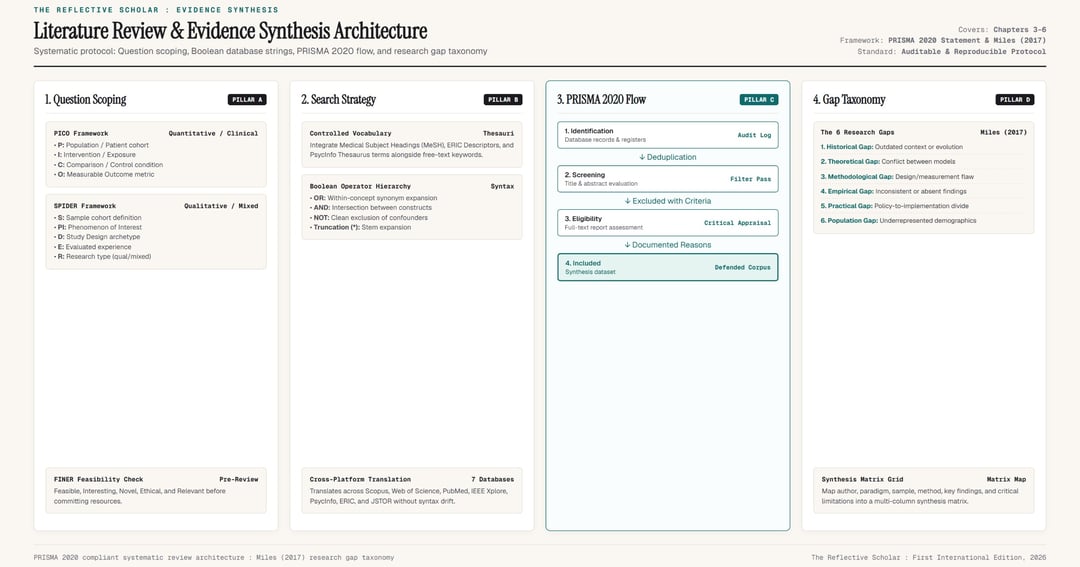
Formulate Defensible Problems: Funnel open curiosities into testable empirical questions using PICO, SPIDER, and the Miles (2017) 6-branch gap taxonomy.
Conduct Systematic Literature Reviews: Construct multi-tier Boolean queries across 7 academic databases, execute PRISMA 2020 screenings, and build multi-column evidence matrices.
Design Airtight Empirical Architectures: Select appropriate qualitative, quantitative, or mixed designs with defensible sampling frames and pre-calculated statistical power.
Enforce Research Governance: Navigate institutional review board (IRB) ethics approvals, participant data protections, and ethical boundaries for Generative AI in scholarship.
Clean Data and Test Hypotheses: Diagnose outliers, verify parametric assumptions (normality, homoscedasticity, multicollinearity), and execute bivariate tests, ANOVA, and multiple regression models with mathematical proofs.
Execute Rigorous Qualitative Analysis: Apply Braun and Clarke's 6-phase reflexive thematic analysis with transparent audit trails and saturation criteria.
Draft Publication-Grade Manuscripts: Implement Swales' Create a Research Space (CARS) model, write 7-move structured abstracts, and build unbroken dissertation consistency chains.
Navigate Peer Review and Dissemination: Build 3-column reviewer rebuttal matrices, apply APA 7th referencing decision trees, design academic conference posters, and leverage Registered Reports to eliminate publication bias.
About the creator

Richizza — From Experience to Understanding. This gives the brand room to expand into books, digital publications, courses, and practical self-development resources without restricting it to motivational quotes or generic inspirational content.
🏬 Visit storeFrequently asked questions
What exactly is The Reflective Scholar about?
The Reflective Scholar is a 451-page practical research manual that covers the entire scholarly inquiry process. It begins with research philosophy and problem formulation, moves through systematic literature reviews, qualitative, quantitative, and mixed designs, statistical analysis, and data hygiene, and concludes with academic writing, APA 7th referencing, peer-review rebuttals, and open science practices.
Who is this book written for?
The book is specifically designed for postgraduate students (Master's and PhD candidates), early-career academics, honours students, research assistants, and independent scholars. It is equally valuable for research supervisors seeking an authoritative, comprehensive reference manual for their laboratories and thesis students.
Does the book explain research methods for beginners?
Yes. The book begins with foundational concepts: clarifying ontology, epistemology, and research paradigms (Postpositivism, Constructivism, Pragmatism) in clear, accessible language. It builds systematically from foundational concepts to advanced empirical techniques without relying on unexplained jargon.
Does it cover both qualitative and quantitative research?
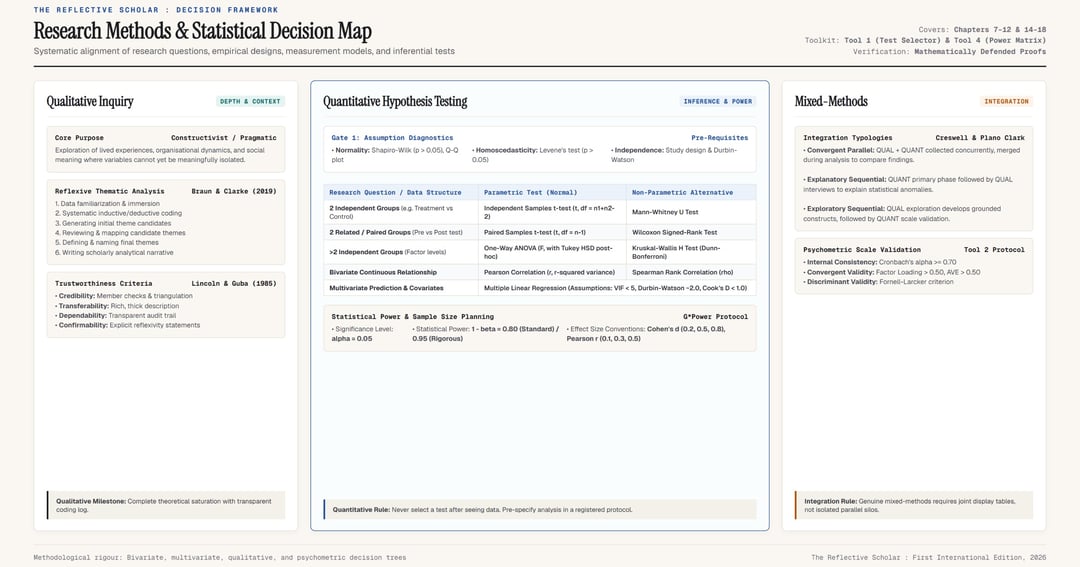
Yes, in full depth. Part 4 dedicates specific chapters to qualitative inquiry stacks, quantitative decision trees, and mixed-methods integration models (Convergent Parallel, Explanatory Sequential, and Exploratory Sequential). In Part 6, quantitative methods are covered through worked statistical examples, while qualitative analysis is detailed through Braun and Clarke's 6-phase reflexive thematic analysis.
What statistical tests and data analyses are included?
The manual covers data hygiene rules, outlier identification, bivariate test selection (Independent Samples t-tests, Paired t-tests, Mann-Whitney U, Wilcoxon Signed-Rank, Pearson correlation, Spearman rho), One-Way ANOVA with Tukey HSD post-hoc testing, and multiple linear regression with complete diagnostic testing (normality of residuals, homoscedasticity, multicollinearity VIF, and influential case diagnostics).
Are there diagrams and visual learning aids?
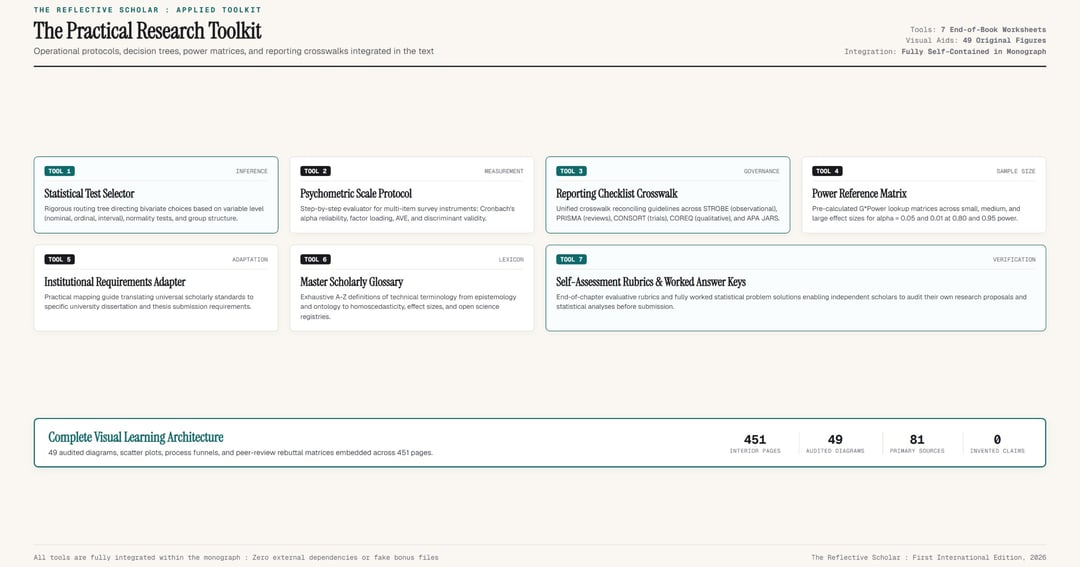
Yes. The book contains 49 original vector diagrams, flowcharts, decision trees, scatter plots, process funnels, and conceptual matrices. Every figure has been engineered specifically to clarify complex research decisions and tested for crisp typographic legibility on screen and print.
Does the book cover dissertation writing and academic publishing?
Yes. Part 7 provides actionable blueprints for academic writing: John Swales' Create a Research Space (CARS) model for introductions, the 7-move structured abstract, the IMRaD hourglass geometry, and an unbroken dissertation consistency chain. Part 8 details peer-review triage, how to construct a professional 3-column reviewer response matrix, conference poster design, and Registered Reports.
Is this book tied to a specific university's formatting guidelines?
No. The Reflective Scholar is an institution-neutral framework based on universal international standards (APA 7th, PRISMA 2020, STROBE, CONSORT, CUDOS). Additionally, Tool 5 in the back of the book is the Institutional Requirements Adapter, which guides scholars on how to map these universal standards to their own university's particular thesis formatting rules.
What digital files do I receive when I purchase?
You receive immediate download access to two digital editions: The Interactive Screen PDF Edition (451 pages, Richizza #FAF7F2 paper tint, fully hyperlinked table of contents and figure cross-references, high-resolution vector illustrations). The Reflowable EPUB3 Edition (formatted with valid semantic HTML5, ready for Apple Books, Kindle, Kobo, and mobile ereaders).
Can I share or redistribute the purchased digital file?
No. Your purchase grants a single personal, non-exclusive license for your own individual research and academic study. Redistribution, mass distribution, resale, or unauthorized uploading to public repositories is strictly prohibited under international copyright law. Institutional site licenses may be requested directly from Richizza Academic & Reflective Editions.
More from Richizza
Check out other products